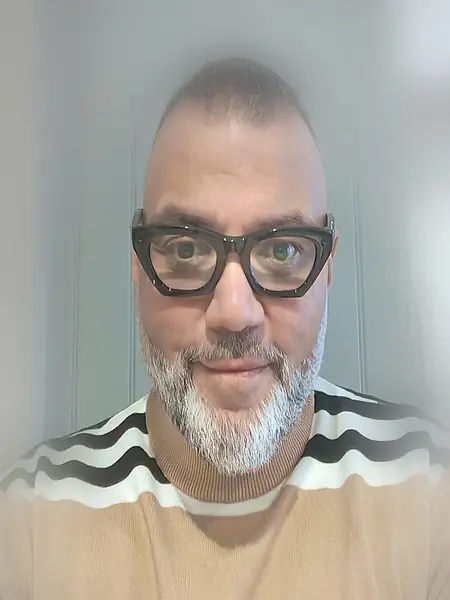
UKCP-registered psychotherapist, Jungian analyst and HCPC-registered art psychotherapist with 25 years of clinical practice, specialising in eating disorders, addiction and trauma.
Most people who find me are not looking for a label. They are looking for someone who can meet what they are actually carrying: a relationship with food or with the body that has taken over, a dependence they cannot break alone, the long shadow of trauma, or a flat, quiet sense that life has lost its meaning.
I treat a human being, not a disorder. My work begins with what sits underneath the symptom rather than with the symptom alone: the person carrying it, the life it belongs to, and what it has been doing for them.
How I understand a symptom
I read a symptom as an attempt at movement. Even when it is destructive, even when it is costing someone their health, their marriage or their work, the behaviour is usually the psyche trying to get somewhere: to manage what cannot yet be felt, to say what has never been said, to survive something that had no other exit.
That does not make it functional. It is often the opposite, and it usually has to change. But treating a symptom purely as a fault to be removed misses what it is carrying, and the work rarely holds. When someone understands what their behaviour was doing for them, and finds another way to do it, the behaviour tends to lose its grip rather than having to be defeated.
How I work
My commitment is to bring more of the unconscious into consciousness. What remains unknown is repeated. What can be recognised can be felt, and eventually chosen. That is the direction of the work, whatever the presenting problem.
Two methods matter particularly to me here. Art therapy, because the image arrives before the explanation, and reaches what words have learned to defend. And EMDR therapy in London, which I have practised for more than twenty years, because it can help people process traumatic memories that continue to generate distress, rather than talking around them indefinitely.
I am an integrative practitioner, which means I do not treat every person with the same method. Some work is practical and close to the surface, particularly at the beginning, when a behaviour has to loosen its grip before anything else becomes possible. Some is psychotherapeutic: understanding the patterns a person has lived inside without seeing them. And some becomes analytic, where the questions turn towards meaning, purpose and, for some people, spirituality.
I spent ten years living in a Buddhist centre, and that has stayed with me. I do not bring it into the room as a belief, but it shaped how I understand attention, suffering, and what it takes to sit with someone else’s.
Sessions are held in English or French. In my experience, working in one’s first language matters more than people expect, particularly with trauma: the material tends to live in the language in which it happened.
How I came to this work
I did not arrive here from theory. I came to it through my own recovery from addiction and an eating disorder, and the years of struggle with my own mental health that surrounded them.
That period taught me two things I have never found in a textbook. The first is how convincing the mind can be when it is defending the very thing that is destroying you. The second is that recovery is not the removal of a behaviour; it is the slow business of finding somewhere else for the feeling to go.
When I began to come out of it, I wanted to understand what had happened to me, and then to be useful to people in the same position. So I trained. I have gone on training ever since: as an integrative psychotherapist, as an art psychotherapist, as a Jungian analyst, in EMDR, and in addiction at the Hazelden Foundation. Twenty-five years later I am still doing both things at once, practising and studying, because the work does not stand still and neither should the person doing it.
For close to a decade of that time I worked inside residential treatment, which is where I learned what that setting can do and where its limits lie. I supervise clinicians in residential centres still. It is the reason I can say honestly, at an assessment, when someone needs to go in, and when private work will serve them better.
Who I work with
Eating disorders, addiction therapy in London and trauma and EMDR therapy in London are the three areas where most of my clinical life has been spent, and I treat them as neighbouring territories rather than separate conditions. They travel together far more often than they appear separately, and treating one while ignoring the others rarely holds. Around them sits the rest of the work: depression, anxiety, identity, and the crises that arrive in mid-life.
Over twenty-five years, a large part of my practice has been with people who live under scrutiny: figures in public life, chief executives and senior leaders. For them exposure is constant, and discretion is not a preference but the condition on which help becomes possible at all. Much of that work is a confidential alternative to residential treatment, or the aftercare that follows it.
I have a specialist interest in men. Male eating disorders were the subject of my doctoral research, and remain the area where the gap between need and provision is widest.
The doctorate
My Professional Doctorate in Analytical Psychology at the University of Essex examined the impact of father and son relationships on a man’s relationship with food and his body, from the perspective of analytical psychology. The thesis, The Devouring Kronos, introduced three concepts I now use daily in clinical work: the Kronos Complex, Body Number 2, and the Male Eating Disorder Matrix.
To my knowledge it remains the only European doctoral research focused specifically on male eating disorders from this perspective. That is less a distinction than an indictment. It should not be unusual, and the men who arrive in my consulting room, often after years of being missed, are the reason it matters.
The practice
Philippe Jacquet & Associates is a founder-led private practice. Clients may be seen by me, or, where it is appropriate, by an Associate working under my clinical supervision and within the approach described across this site. The choice is always yours, and fees differ accordingly.
Consultations take place at Harley Street, London W1, in Fitzrovia, central London, in Bermondsey, south east London, in Colchester, Essex, and online by secure video for clients internationally. There is usually no waiting list, and an initial consultation is usually available within the week.
Professional registration and membership
- UKCP, registered psychotherapist
- HCPC, registered art psychotherapist
- British Psychoanalytic Council, registered
- Association of Jungian Analysts, analyst, supervising analyst and training analyst, and member of the International Association for Analytical Psychology (IAAP)
- BAAT, member
Training and qualifications
- Professional Doctorate in Analytical Psychology, University of Essex (2026)
- Analyst, Association of Jungian Analysts (2018); supervising analyst and training analyst
- MA in Adult Integrative Art Psychotherapy, Institute for Arts in Therapy and Education
- International Diploma in Addiction Counselling, Hazelden Foundation
- Diploma in Counselling for Eating Disorders, National Centre for Eating Disorders
- EMDR practitioner, more than twenty years
- Executive coaching, ESSEC Business School
- Clinical supervisor to residential treatment centres, including private residential and psychiatric settings
The doctoral research is described in more detail on the research page. On coming into this work through my own addiction, see from junky to doctor.
Research identifiers: ORCID 0009-0002-3578-6579 · Google Scholar · Doctoral thesis DOI 10.5526/ERR-00042825
Also listed on Psychology Today, Counselling Directory, Bupa and Welldoing.
Whatever brought you here, whether a quiet ache or a loud crisis, it deserves a serious response. Arrange a confidential consultation.
See also: therapy in London.