
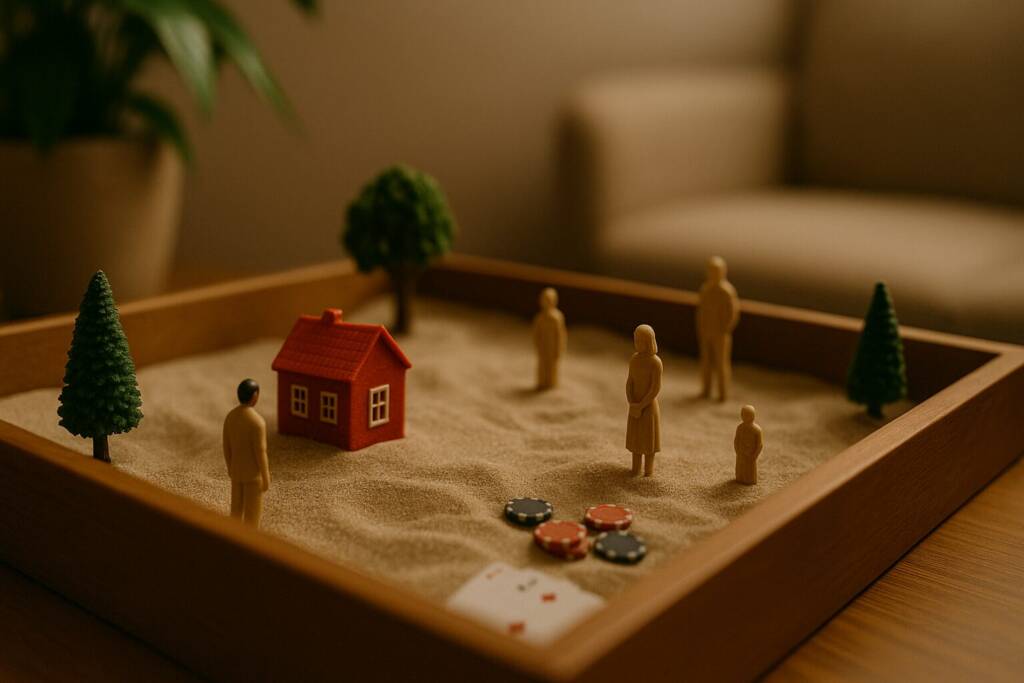
Sand Tray Therapy
Sand tray therapy — sometimes called sandplay therapy — is a projective technique developed within the Jungian tradition in which a client creates a scene or world using sand and miniature figures in a bounded tray. The process is non-verbal: the client arranges the scene without being directed, and the scene is then explored in reflection with the therapist. What emerges is often strikingly revealing of internal states, relationships, and conflicts that the person was not consciously aware of holding.
The technique was developed by Dora Kalff in dialogue with Jung’s concept of the active imagination, and it shares with art therapy the fundamental premise that significant psychological material can be accessed through symbolic, non-verbal means that verbal therapy alone cannot reach. The bounded sand tray functions as what Kalff called a free and protected space — a container in which material from the unconscious can be expressed safely.
What sand tray sessions involve
The client is given access to a sand tray and a range of miniature objects — figures of people and animals, buildings, trees, natural objects, symbolic items — and invited to create whatever they want in the sand. There is no instruction about what to create or how to use the materials. The therapist observes without directing or interpreting during the making process.
After the tray is complete, there is a reflective conversation: what the scene carries for the person who made it, what figures or arrangements draw their attention, what feelings the scene evokes. The therapist brings the Jungian symbolic vocabulary where it is relevant, but the primary interpretive work remains with the client.
Who it is appropriate for
Sand tray therapy is appropriate for adults and young people across a range of presentations. It is particularly useful for trauma — where the ability to externalise and contain experience symbolically is often more tolerable than verbal processing — and for clients who find verbal therapy limited. It is also used effectively in eating disorder treatment and with clients in Jungian analysis who want to work with dream imagery and internal figures in a three-dimensional form.